No products in the cart.

Professional invoice examples for b2b businesses explained with practical steps, common mistakes, examples, FAQs, and relevant Invopoint tools for small businesses, finance teams, and B2B service providers.
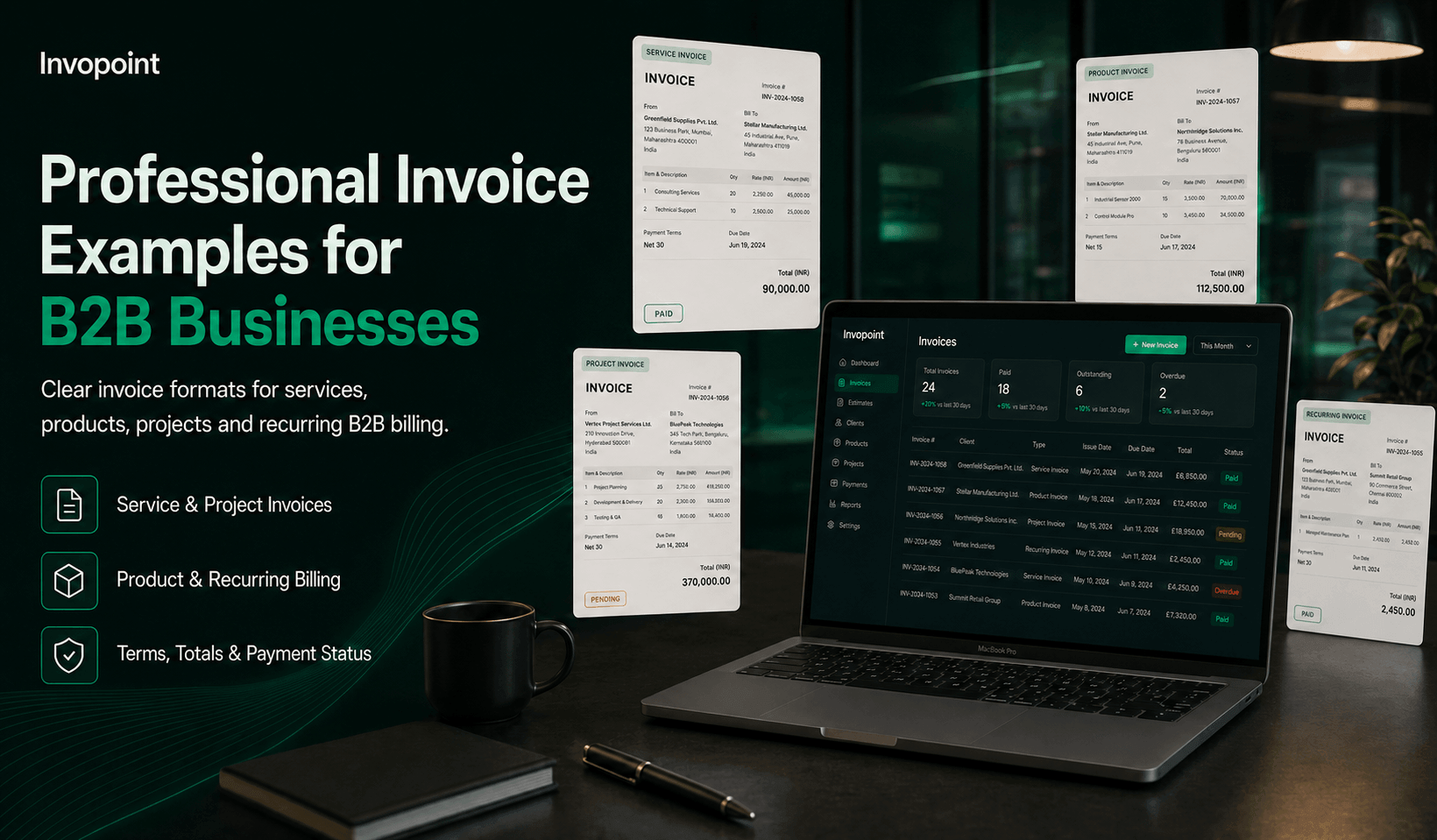
A reliable approach to professional invoice examples for b2b businesses combines commercial clarity, accurate data, visible responsibility, and timely follow-up. Software can support those controls, but it cannot replace a decision about how the workflow should operate.
An invoice is a commercial document that records what a seller supplied, what the customer owes, when payment is due, and how payment should be made. This guide explains the operating choices, controls, measures, and common errors relevant to professional invoice examples for b2b businesses.
Contract, tax, payment, and record-retention requirements vary by jurisdiction. Treat this article as operational guidance and confirm material legal or tax decisions locally.
In practical terms, the business should confirm the legal business and customer details, describe the supplied work in language the buyer can verify, and calculate subtotal, discounts, tax, and the final balance. It should then assign a unique invoice number and an unambiguous due date and send the invoice through a traceable channel and retain the record. This sequence supports the main objective: issue clear, professional invoices that clients can approve and pay with less friction.
The most useful way to assess professional invoice examples for b2b businesses is to follow one representative transaction from commercial agreement through billing, customer approval, payment, and reconciliation. This reveals gaps that a generic checklist can miss.
Incomplete or inconsistent invoices create avoidable questions, corrections, and payment delays. The cost is not limited to administrative time. It can affect customer trust, working capital, reporting accuracy, and the team’s ability to forecast what happens next.
The strongest approach treats professional invoice examples for b2b businesses as part of the invoice-to-cash system. Sales terms, delivery evidence, customer master data, billing, payment, and reconciliation should agree. When one stage uses different information, the exception usually appears later as a correction, dispute, or overdue balance.
For management, the objective is issue clear, professional invoices that clients can approve and pay with less friction. That requires a process owner, a consistent routine, and a small number of measures that reveal whether the workflow is improving.
Consider a small B2B service company that wants to improve professional invoice examples for b2b businesses. The team documents its current steps and discovers that customer references arrive through email, important values are entered manually, and nobody owns rejected transactions. Rather than replacing every system immediately, it standardizes the required data, defines a review point, and assigns exception ownership.
During the first month, the team monitors invoice error rate, average approval time, and days from issue to payment. The figures are useful, but the reason codes are more valuable. They show which delays come from missing information, customer approval, commercial disputes, or internal workload. The business then fixes the largest repeated cause and measures the next cycle.
This example matters because a tool alone does not produce the result. Improvement comes from combining accurate inputs, a defined process, appropriate automation, and management follow-through.
Use the Payment Processing Fee Calculator to turn part of this topic into a practical calculation or document. The free tool provides an immediate result and a transparent starting point for the next business decision.
For a wider workflow, Online Invoicing Software connects invoice creation, client records, payment tracking, recurring billing, and reporting. The article explains the decision, the tool supports the calculation, and the product page shows how the process can be managed over time.
Browse the complete collection at 100 free business calculators. Each tool provides an immediate calculation that can support pricing, billing, tax, cash-flow, or operating decisions.
These supporting articles cover adjacent search questions without repeating the same primary search intent.
An invoice is a commercial document that records what a seller supplied, what the customer owes, when payment is due, and how payment should be made. In practice, the exact implementation should reflect the contract, customer process, and jurisdiction.
Incomplete or inconsistent invoices create avoidable questions, corrections, and payment delays. A controlled approach helps the business issue clear, professional invoices that clients can approve and pay with less friction.
Useful measures include invoice error rate, average approval time, days from issue to payment. Select a small set that leads to action instead of building a dashboard nobody owns.
Invopoint helps B2B businesses create professional invoices, maintain client records, track paid and overdue balances, support online payments, and review billing activity in one workspace.
Management should distinguish processing speed from process quality. Faster output is not an improvement if corrections, disputes, write-offs, or manual reconciliations increase during the same period. Use percentage paid without follow-up as a decision measure, not a decorative dashboard value. Set a review frequency, an acceptable range, and a named response when the result moves outside the expected level.
The operating procedure should explain the normal case in plain language and link unusual cases to a reviewer. This keeps everyday work efficient without allowing complex transactions to bypass appropriate control. When software is configured, mirror the approved commercial process. Customer records, service items, tax settings, payment terms, reminders, permissions, and reports should use the same definitions as the contract and finance policy.
A pilot should include at least one standard transaction, one correction, one overdue balance, one customer query, and one exception. Testing only the ideal path creates confidence without proving that the workflow can recover safely. The audit trail should answer who created the record, who approved it, what changed, when communication occurred, and how the final balance was resolved. This information supports both management review and customer service.
Do not automate an exception simply because it occurs frequently. First determine why it occurs, whether the underlying rule is correct, and whether better source data could remove the exception entirely. A practical control for seller and buyer details should be proportionate to value and risk. Low-risk routine work can move quickly, while unusual values, customer changes, or jurisdiction-specific treatment may require an additional review.
Reporting should separate timing problems from accuracy problems. An invoice can be correct but late, or timely but incomplete, and each failure requires a different operational response. Review the workflow from the customer perspective as well as the internal perspective. A process that is efficient for the seller may still delay payment if the buyer cannot match the invoice to an approved purchase or delivery record.
Document reason codes for corrections, rejections, disputes, and delayed payments. A short controlled list makes recurring causes visible and supports a focused improvement plan instead of anecdotal debate. The team should reconcile statuses with financial reality. Sent, viewed, approved, paid, partially paid, disputed, written off, and cancelled must have precise meanings and should not be inferred from an email thread.
For cross-border work, confirm currency, tax treatment, legal entity, customer location, payment route, and record-retention requirements before the first invoice. Retrofitting these decisions later can create avoidable corrections. Changes should be introduced with an owner, effective date, documented rationale, and success measure. Without these elements, the business cannot tell whether results changed because of the new process or normal variation.
Training should use real scenarios and role-specific instructions. A billing administrator, sales lead, delivery manager, and finance reviewer need different details even when they participate in the same end-to-end process. Access should follow responsibility. Users need enough permission to complete their role, while approvals, sensitive changes, refunds, write-offs, and configuration updates should remain restricted and reviewable.
Month-end review should not be the first time the business notices an issue. Weekly visibility into exceptions, overdue balances, rejected records, and incomplete customer information allows smaller corrective actions.
For professional invoice examples for b2b businesses, consistency matters more than adding another isolated tool. Define the rule, keep the supporting data complete, make exceptions visible, and review the result after a real billing cycle.
Invopoint helps businesses create professional invoices, maintain client records, support online payments, track paid and overdue balances, and review billing activity. Start with the online invoice generator or explore the free business calculators for the next practical step.

 Anton Liashenko
Apr 17, 2024
 Anton Liashenko
Apr 24, 2024
 Anton Liashenko
Nov 17, 2023
 Anton Liashenko
Nov 13, 2023
 Anton Liashenko
Nov 08, 2023