No products in the cart.

Plan UK tax deadlines, invoices, VAT, PAYE, payments, and cash flow with Invopoint online invoicing software for SMBs and freelancers.
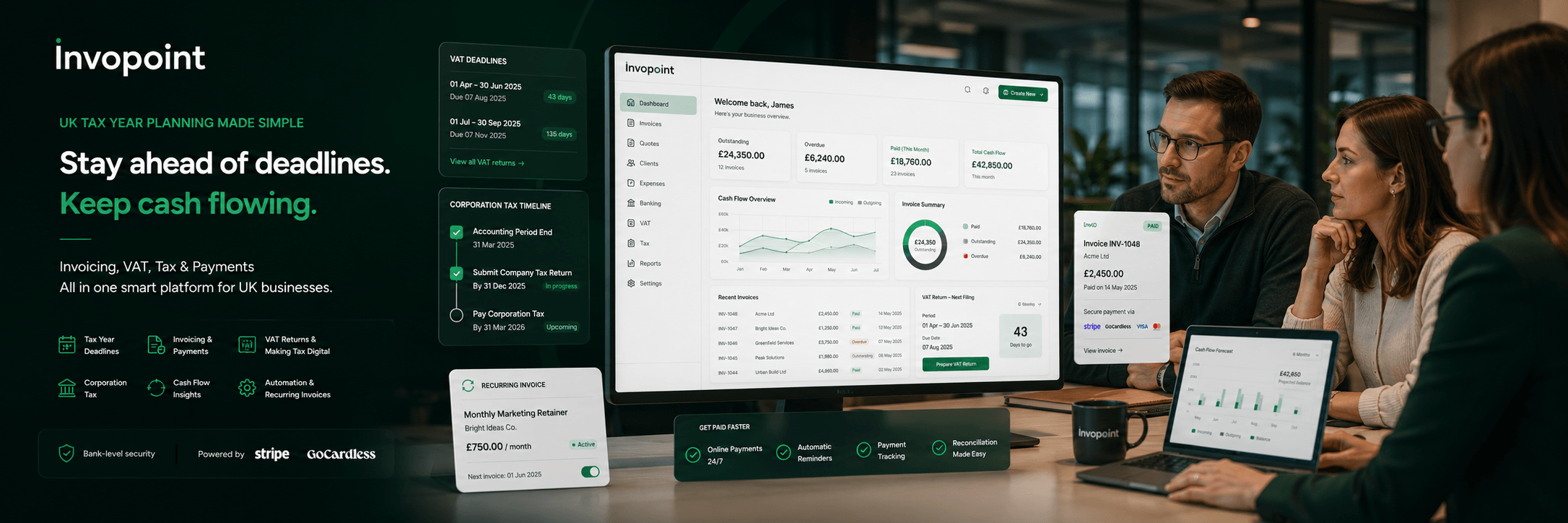
The UK tax year affects how freelancers, limited companies, landlords, consultants, agencies, and SMBs organise income records, invoices, VAT returns, payroll payments, and year-end financial planning. The 2025-26 tax year started on 6 April 2025 and ended on 5 April 2026.
For businesses that issue invoices, accept online payments, and track client balances, deadline management becomes easier when finance data is structured throughout the year. Invopoint helps businesses use online invoicing software to create invoices, monitor payments, organise client billing, and maintain clearer records before tax season arrives.
The UK tax year runs from 6 April to 5 April of the following year. This period is used for income tax, Self Assessment, personal allowances, capital gains tax planning, and many individual tax records.
For business owners, the tax year is more than a filing date. It is the framework for organising invoices, supplier bills, online payments, expense records, payroll activity, VAT information, and cash flow forecasting.
The main Self Assessment deadlines for the 2025-26 tax year apply after the year ends. Taxpayers who need to complete a return should usually register by 5 October 2026, paper returns are due by 31 October 2026, and online tax returns plus any tax owed are due by 31 January 2027.
Using an online invoice generator during the year helps reduce year-end pressure because income, payment status, and client billing history are easier to review before returns are prepared.
Tax deadlines are not only compliance events. They influence available cash, payment timing, invoice collection, payroll obligations, VAT reserves, and owner drawings. A missed filing date can create penalties, but a missed cash flow signal can create a wider operational problem.
Businesses should track:
A structured invoice management software workflow gives business owners a clearer view of what has been billed, what has been collected, and what still needs to be followed up.
Self Assessment usually matters for self-employed professionals, sole traders, landlords, company directors with additional income, and individuals with untaxed income. For the 2025-26 tax year, online returns can usually be submitted from 6 April 2026 up to the 31 January 2027 deadline.
For freelancers, clean invoice records are essential. Each client invoice, payment confirmation, overdue balance, refund, and business expense can affect the quality of year-end financial records.
Invopoint supports invoicing for freelancers by helping users create professional invoices, track payment status, and maintain organised billing records in one cloud invoicing platform.
Limited companies follow company-specific deadlines based on their accounting period. Annual accounts are usually due to Companies House 9 months after the company financial year ends, Corporation Tax payment is usually due 9 months and 1 day after the accounting period ends, and the Company Tax Return is usually due 12 months after the accounting period ends.
For limited companies, invoice accuracy directly affects revenue reporting, debtor control, VAT records, and management accounts. A reliable invoice software for small business can help directors keep commercial billing activity aligned with accounting preparation.
VAT-registered businesses usually need to send a VAT Return every 3 months. The online VAT Return deadline is usually one calendar month and 7 days after the end of the accounting period, and this is normally also the deadline for payment.
The UK VAT registration threshold increased from £85,000 to £90,000 from 1 April 2024, meaning businesses with taxable turnover above that threshold must usually register for VAT.
Invopoint helps businesses maintain structured invoice and payment data through a secure invoicing solution designed for SMBs, freelancers, agencies, and service businesses.
Employers must manage payroll obligations throughout the year. PAYE amounts owed to HMRC are generally due by the 22nd of the month, or by the 19th if paying by post.
For businesses with employees, payroll deadlines should be reviewed alongside invoices, cash inflows, client payment terms, and supplier obligations. This makes payment timing more predictable and reduces pressure around monthly commitments.
Tax deadline management improves when the business treats invoicing, payment collection, and financial records as a continuous process rather than a year-end task.
With Invopoint, businesses can use invoice automation software to reduce manual billing work, support recurring invoices, and improve visibility over outstanding payments.
Late client payments can create a timing gap between tax obligations and available cash. When businesses can accept online payments, clients have a faster and clearer way to pay invoices by card or other supported payment methods.
Online payment solutions are especially useful for:
A modern payment processing software workflow helps reduce unpaid invoices, improve cash flow, and make financial reporting easier before tax deadlines.
Recurring invoice software is valuable for businesses with monthly retainers, ongoing service contracts, subscriptions, maintenance plans, or regular client billing. Instead of manually recreating the same invoice each month, businesses can build a more predictable billing cycle.
For SMBs, recurring billing data can support better planning around VAT, PAYE, Corporation Tax reserves, and Self Assessment payments on account.
Good tax preparation starts with accurate financial records. Businesses should keep a complete view of money earned, money received, tax collected, expenses paid, and invoices still outstanding.
Invopoint’s digital invoicing platform helps businesses organise invoice creation, invoice tracking, payment collection, and billing records from one modern workspace.
Invopoint is built for businesses that need a practical way to create invoices, send them to clients, track payments, and improve billing visibility. It does not replace professional tax advice, but it helps keep the commercial records that accountants and business owners rely on during tax preparation.
Businesses can start with Invopoint’s cloud invoicing platform to simplify day-to-day billing and make financial records easier to manage throughout the UK tax year.
The UK tax year starts on 6 April and ends on 5 April of the following year. The 2025-26 tax year started on 6 April 2025 and ended on 5 April 2026.
For the 2025-26 tax year, online Self Assessment tax returns and payment are usually due by 11:59pm on 31 January 2027.
VAT returns are usually due one calendar month and 7 days after the end of the VAT accounting period, and this is usually also the payment deadline.
Yes. Online invoicing software helps businesses organise invoices, payment status, client balances, recurring billing, and revenue records. This makes tax preparation more efficient and reduces the risk of missing important billing information.
Invopoint is an invoicing platform, not a tax filing service. It helps businesses create invoices, track payments, accept online payments, and maintain structured billing records that can support accountants and business owners during tax preparation.
UK tax deadlines are easier to manage when invoices, payments, VAT records, payroll obligations, and cash flow are organised throughout the year. Freelancers, SMBs, consultants, agencies, and limited companies should treat invoicing as part of financial control, not only as an administrative task.
Invopoint gives businesses a modern invoicing platform for creating invoices, tracking payments, accepting secure online payments, and keeping billing records clearer before each tax deadline arrives.

 Anton Liashenko
Apr 17, 2024
 Anton Liashenko
Apr 24, 2024
 Anton Liashenko
Nov 17, 2023
 Anton Liashenko
Nov 13, 2023
 Anton Liashenko
Nov 08, 2023